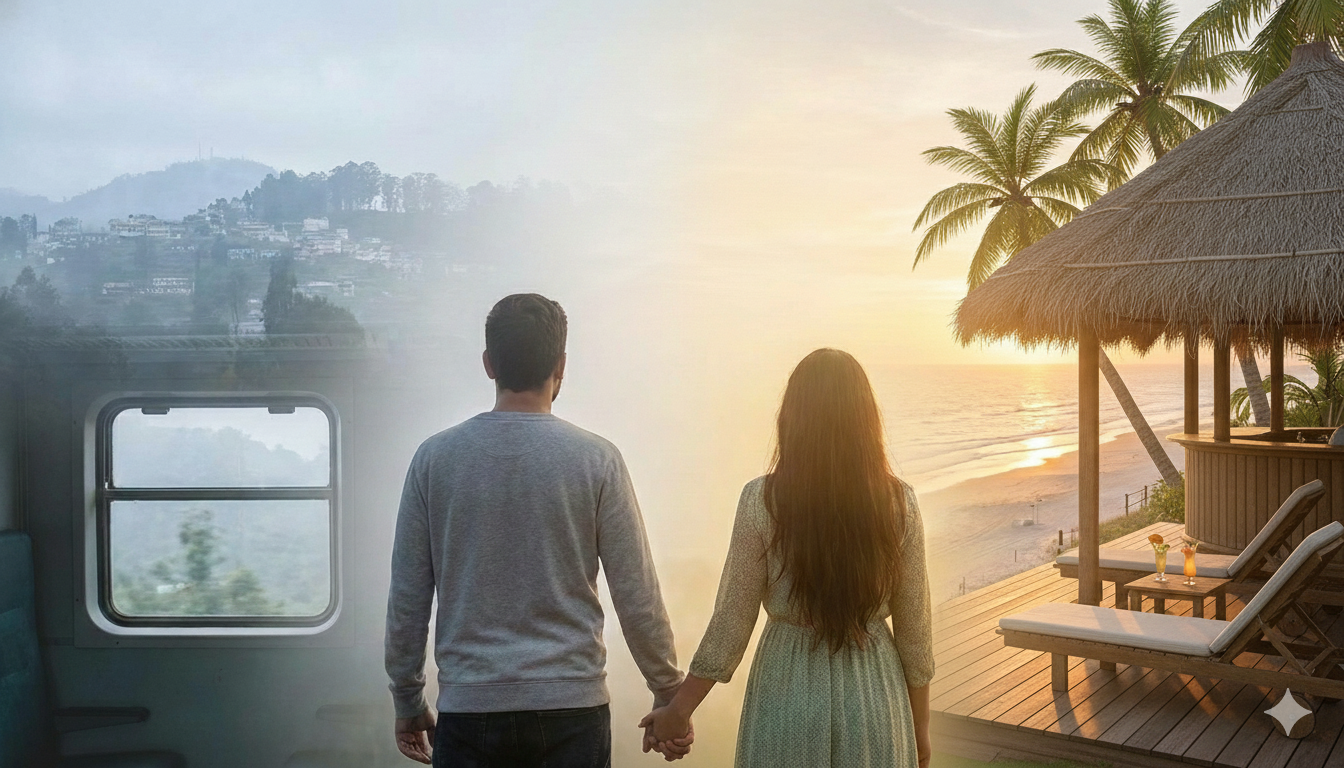
Travel and I never had an easy relationship. I was never the kind of person who longed for new places or felt excitement at the idea of going somewhere unfamiliar. I was the opposite — a quiet, home-bound girl who preferred the safety of familiar walls. New places made me uneasy, and the world outside felt too large, too demanding. So travel was never an escape for me; if anything, I tried my best to escape travel.
I remember only fragments of my earliest journeys—the family story of a trip to the hills when I was barely a year old, the faded photographs of Digha when I was about four. Those pictures are small islands of light in a sea of ordinary days. We did not travel much; we did not go out for treats or dinners as other families did. Home was where things happened, and most pleasures were made there.
The first trip I truly remember was when I was in eleventh grade. We went to Madhupur: my parents, my maternal aunt and uncle with their children, my father’s colleague and her son. My elder sister was already married then, so she did not come. Those five days felt gently different from everything else I had known—new routines, the quiet pleasure of being somewhere that wasn’t home, the small excitement of a shared journey.
A year later, in twelfth grade, I finally went to Varanasi, a place I had wanted to see for as long as I can remember. I am drawn to Shiva, to the sound and rhythm that seem to belong to that city. Standing by the ghats, I wanted to feel that hum in my bones, to watch the chants and smoke and the slow, steady life of the river. We saw forts and monuments too—plans shaped by others—but Varanasi left its own quiet mark on me. It felt like a place I had been waiting for.
Some memories of trips are threaded with small hurts. In 2012 we went to the Kolkata Book Fair because my mother wanted to go. The fair was crowded, the parking far away, the roads uneven. My father walked ahead; my mother moved more slowly, and I kept glancing behind to help her. At one point I fell on the path while hurrying to keep up. I remember the sting, the scramble, holding my mother’s arm and worrying she might fall. That walk home was a small, heavy lesson: the day we had thought would be lovely turned into a reminder of how easily plans fray when bodies get tired. After that day my mother and I quietly decided not to ask again.
Not all journeys were small. In 2013 we went to Puri—my parents, my sister, her husband, their son, her in-laws, her brother-in-law. It was a large, warm group and the days held a kind of uncomplicated joy: temple bells, shared meals, the sea wide and steady. Those memories are bright and full; I can still feel the comfort of being together in one place, a family spread across sand and steps.
There were trips for other reasons too. In 2014 we traveled for treatment to Andhra Pradesh, and my parents made a small temporary home in a rented two-bedroom where my mother cooked in one corner. Later, another treatment trip took us to Hyderabad—this time with my parents, my sister, her husband, and their little boy. Illness puts everything in perspective; sightseeing becomes secondary to the quiet rhythms of care, to waiting rooms and medicines and small comforts offered in tense hours.
Marriage changed many things slowly. We were married at Isha Yoga Center in Coimbatore, and that place felt instantly gentle and true. A month later I returned with my husband and had the privilege of spending a few hours in the Alayam with Sadhguru and other devotees. Those hours were still and deep, and they touched me in a way that did not need loud words.It felt like something within me was quietly unfolding—Sitting there, I could feel my breath and my being settle into a silence that felt older than my life. It was not emotion; it was recognition. A stillness that felt sacred, as though for a brief moment, the boundary between myself and something vast had dissolved.
From Agra, we drove to Mathura and Vrindavan, and it felt like entering a world made of devotion itself. The tiny lanes, the ringing bells, the soft dust on the temple floors — everything felt ancient, tender, and strangely familiar, as if the place had been waiting for me. And then, Khajuraho was another kind of wonder altogether. The temples stood in silence, carved with such impossible detail that it felt unreal — every figure, every curve, every story etched in stone as if time had bowed before it. When I walked among them, it felt as if the stones were breathing, holding centuries of stories within them.From there we went to Panna Tiger Reserve, where I had my first jungle safari. I still remember the feeling — the deep silence of the forest, the sudden crack of a branch, the green light filtering through the trees. For the first time, I understood why animals choose to live in the jungle — not just for refuge, but for the sheer, overwhelming beauty that breathes in every leaf and silence. A beauty so ancient and alive that it holds you without asking, and you suddenly know why nothing in the world could tempt them away from it.
Everything shifted more quietly in 2023. We planned a longer route that would change how I understood travel: Shirdi first, where we stayed for seven days and, one day, took a trip to Nashik and returned to Shirdi by evening. From Shirdi we went to Pune and spent the day there, staying in a hotel before catching a midnight train to Hampi. We lived in a homestay in Hampi for seven days—stones and sunlight, long quiet hours that softened me. From Hampi we reached Madgaon station and from there went to Gokarna, where we stayed three days. The drive my husband took afterwards—four hours along a road that wound through green trees and small hills—still unfolds in my mind like a film; it led us to Arambol in Goa.
In Arambol we rented a small studio apartment and stayed for two months. Those months were a kind of slow happiness I had not known before. We cooked together—my husband bought the ingredients, I cooked, sometimes he would cook—and most days we would walk to the sea. The apartment, the market trips, the small rituals of shopping and chopping and stirring became our ordinary. Eating out was rare; we preferred the food we made, the safety of our own kitchen, the way a meal made by hand feels like care. People we met there—travellers from France, an Australian couple, a British pair—became part of those months in a way that felt intimate and easy, as if we had met old friends even on first greetings.
From Goa we went to Coimbatore and stayed at our guru’s ashram for seven days. The ashram has always been our home—quiet, steady, a place where the stillness of the Alayam matched the domestic peace we made in rented rooms. Then we returned to Kolkata.
Later, after three months apart while my husband was away, he returned and we went to Sikkim for two months. Those days in the mountains were gentle healing: slow mornings, long walks, hot tea and soft talks. Sikkim held us in a quiet way that fixed small breaks inside me.
What changed most across these journeys was not the number of places I had seen. It was how I learned to be with someone and to be with myself. With my husband, travel stopped being a checklist and became a way of finding home in new rooms and new streets. We learned the lanes; we asked the names of small shops; we sat with strangers who turned into friends. We learned that home can be a studio by the sea, a homestay in Hampi, the Alayam for a few sacred hours, or a kitchen where we make dal together.
Somewhere along that long, winding journey, something inside me changed. I realized it wasn’t the places alone that gave me this sense of ease, but the presence of my husband — the one person with whom the world feels softer, lighter, more forgiving. With him, I can be completely myself: eating at odd times, wearing whatever I feel like, being messy or quiet or playful, without judgment or pressure. There is no need to follow a strict itinerary or worry about disappointing anyone; with him, we move freely, without rules, letting each day unfold at its own pace.
Wherever I go with him, I find home. The sea, the hills, the temple steps, the quiet ashram — each place folds into the other, and in the middle of it all is the steady, simple feeling that we have made a life that moves gently through the world together.
Travel is no longer about distance.
It is about a feeling —
the feeling of home that we carry together.